-
E-mail
mike@sgnprocess.com
-
Phone
13681679740
-
Address
900 Zhudai Road, Jiading District, Shanghai
Product Categories
Shanghai Sijun Machinery Equipment Co., Ltd
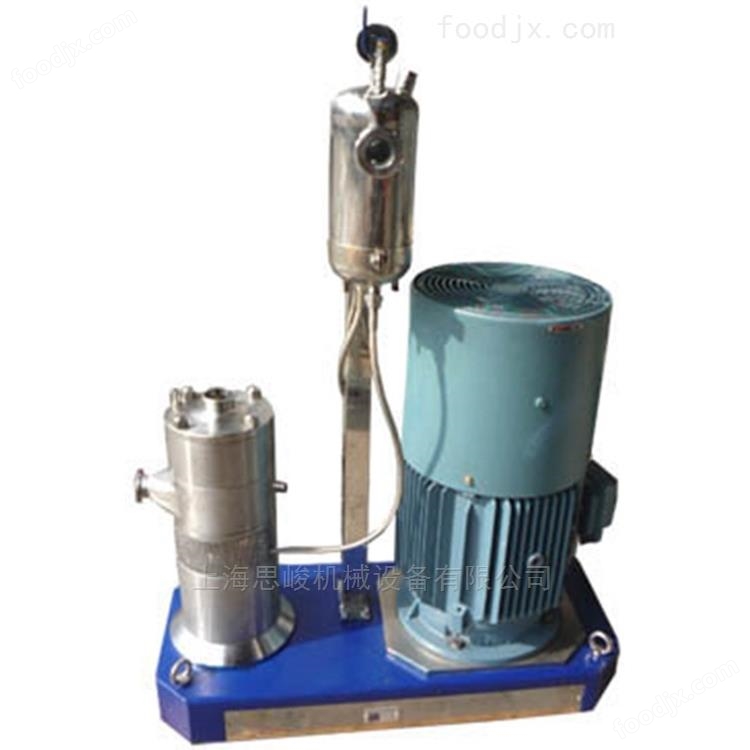


Printing ink disperser
NegotiableUpdate on 01/06
- Model
- Nature of the Manufacturer
- Producers
- Product Category
- Place of Origin
Overview
The printing ink disperser $r $n ① has a very high shear speed and shear force, with a particle size of about 0.2-2 microns to ensure the stability of high-speed homogeneous emulsification. The device can be applied to various homogeneous emulsification processes and can also be used for producing homogeneous mixtures of emulsions, suspensions, and colloids. The shear force generated by the stator and rotor systems of the three-stage emulsifier increases the solute transfer rate, thereby accelerating the decomposition of single molecules and macroscopic molecular media.
Product Details
Printing ink disperser
Printing ink disperserThe machine, ink disperser, and printing ink high shear disperser have a speed that is 4-5 times faster than ordinary dispersers, with excellent dispersion, emulsification, homogenization, and grinding effects. The speed can reach 14000 RPM.
Ink is a homogeneous mixture composed of colored materials (such as pigments, dyes, etc.), binders, fillers, additives, and other substances; Capable of printing and drying on the printed object; It is a paste like adhesive with color and a certain degree of fluidity. Therefore, color (hue), body structure (viscosity, flowability, and other rheological properties), and drying performance are the three most important properties of ink. There are many types of them, and their physical properties are also different. Some are very thick and sticky; But some are quite rare. Some use vegetable oil as a linking material; Some use resin and solvents or water as binders. These are determined based on the printing object, including the substrate, printing method, type of printing plate, and drying method.
With the development of printing technology, the variety of ink is constantly increasing, and there are also many methods for classification. If classified by printing method, there are five types: relief printing ink: book black ink, rotary black ink, color relief ink, etc; Offset printing ink: offset glossy resin ink, offset rotary ink, etc; Gravure printing ink: gravure ink for photography, gravure ink for carving, etc; Orifice printing ink: transcription ink, screen printing ink, etc; Special printing inks: foam ink, magnetic ink, fluorescent ink, conductive ink, etc. The process of ink preparation is relatively complex. Generally, pigments, binders, and various additives are mixed in a certain proportion in an ink mixer to form an oily paste, and then repeatedly ground in a roller mill or medium to evenly disperse the pigments into fine particles in the binder.
The basic components of ink formula include 5% -25% dye, 5% -15% film-forming agent, 30% -60% solvent, 5% -20% homogenizer, and 2% -10% other additives
Price negotiation, the company has prototypes available for customers to experiment with. We welcome customers to visit and guide us!
Printing ink disperser
【printing inkhomogenizerCharacteristics of []
① It has a very high shear speed and shear force, and a particle size of about 0.2-2 microns can ensure the stability of high-speed homogeneous emulsification.
② This device can be used for various homogeneous emulsification processes, as well as for the production of homogeneous mixtures including emulsions, suspensions, and colloids.
③ The shear force generated by the stator and rotor systems of the three-stage emulsifier increases the solute transfer speed, thereby accelerating the decomposition of single molecules and macroscopic molecular media.
A high shear homogenizer is a device that efficiently, quickly, and uniformly transfers one or more solid phases into another immiscible continuous phase (usually liquid). When the fineness of one or more materials reaches the micrometer or even nanometer level, the system can be considered homogeneous. When external energy is input, the two materials recombine into a homogeneous phase.High shear homogenizerDue to the high tangential velocity generated by the high-speed rotation of the rotor and the strong kinetic energy brought by high-frequency mechanical effects, the material is subjected to strong mechanical and hydraulic shear, centrifugal compression, liquid layer friction, impact tearing, and turbulence in the narrow gap between the stator and rotor, forming a suspended liquid. The high shear disperser instantly disperses and homogenizes immiscible solid, liquid, and gas phases uniformly and finely under the combined action of corresponding processing techniques and appropriate additives, and passes through high-frequency processingPipeline type high shear disperserThe cycle repeats itself, ultimately resulting in stable high-quality products.
The factors that affect the dispersion results are as follows
1. DispersionThe form of the head (batch and continuous) (continuous is better than batch)
2 dispersionThe shear rate of the head (the higher, the better the effect)
3 dispersionThe tooth structure of the head (divided into initial teeth, middle teeth, fine teeth, ultra-fine teeth, with fine teeth having better effect)
4 The residence time of materials in dispersed walls, emulsification dispersion time (can be regarded as the same motor, the smaller the flow rate, the better the effect)
5 The more cycles (the better the effect, but by the end of the device's lifespan, it cannot be any better)
Calculation of linear velocity
The definition of shear rate is the relative velocity of the liquid layer between two surfaces.
–Shear rate(s-1) =vSpeed(m/s)
gfixed-Rotor spacing(m)
As can be seen from the above, the shear rate depends on the following factors:
–Linear velocity of rotor
–In this situation, the distance between the two surfaces is the rotor-Stator spacing.
fixed-The spacing range of the rotor is0.2 ~ 0.4 mm
rateV= 3.14 X D(rotor diameter)XRotational speedRPM / 60
High rotational speed and shear rate are crucial for obtaining ultrafine suspensions. According to some industry specific requirements, SGN has developed the GRS2000 ultra high speed disperser based on the ER2000 series. Its shear rate can exceed 14000 rpm, and the rotor speed can reach 40m/s. Within this speed range, turbulence caused by shear forces combined with specially developed motors can reduce the particle size range to the nanometer level. The shear force is stronger and the particle size distribution is narrower. Due to its high energy density, no other auxiliary dispersion equipment is required.
Printing ink disperser
High shear homogenizer disperser is applied to: |
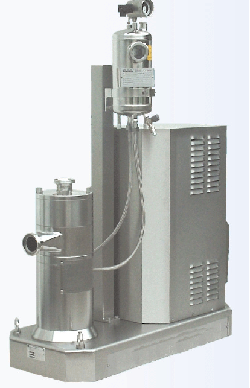 |
High shear homogenizer disperser is particularly suitable for:
|
Ultra high speed homogenizer disperserEquipment level: chemical grade, hygiene level I, hygiene level II, sterile grade
Ultra high speed homogenizer disperserMotor form: ordinary motor, variable frequency speed regulation motor, explosion-proof motor, variable frequency explosion-proof motor, pneumatic motor
Ultra high speed homogenizer disperserPower supply selection: 380V/50HZ, 220V/60HZ, 440V/50HZ
Ultra high speed homogenizer disperserMaterial: SUS304 SUS316L 、SUS316Ti
Ultra high speed homogenizer disperserSurface treatment: polishing, wear-resistant treatment
Ultra high speed homogenizer disperserImport and export connection forms: flange, screw, clamp
|
High shear homogenizer disperser |
Standard flow rate (H2O) |
output speed |
Standard linear velocity |
Motor power |
import and export dimensions |
model |
l/h |
rpm |
m/s |
kW |
|
GRS 2000/4 |
300-1,000 |
14000 |
40 |
2.2 |
DN25/DN15 |
GRS 2000/5 |
1,000-1.5000 |
10,500 |
40 |
7.5 |
DN40 /DN 32 |
GRS 2000/10 |
3,000 |
7,300 |
40 |
15 |
DN50 / DN50 |
GRS 2000/20 |
8,000 |
4,900 |
40 |
37 |
DN80 /DN 65 |
GRS 2000/30 |
20,000 |
2,850 |
40 |
75 |
DN150 /DN 125 |
GRS 2000/50 |
40,000 |
2,000 |
40 |
160 |
DN200 /DN 150 |
The upper limit processing capacity in Table 1 refers to the measurement data of the medium being "water".
The processing capacity depends on the viscosity, consistency, and final product requirements of the material.
Printing ink disperserThe machine, ink disperser, and printing ink high shear disperser have a speed that is 4-5 times faster than ordinary dispersers, with excellent dispersion, emulsification, homogenization, and grinding effects. The speed can reach 14000 RPM.
Similar Product Recommend

