-
E-mail
mike@sgnprocess.com
-
Phone
13681679740
-
Address
900 Zhudai Road, Jiading District, Shanghai
Product Categories
Shanghai Sijun Machinery Equipment Co., Ltd
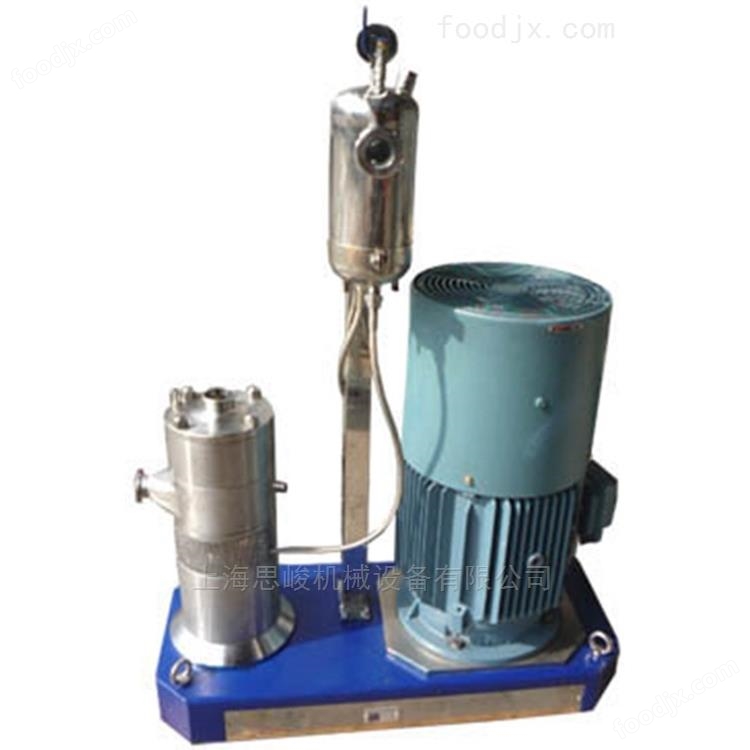


High speed disperser for in-situ polymerization of nanomaterials
NegotiableUpdate on 01/06
- Model
- Nature of the Manufacturer
- Producers
- Product Category
- Place of Origin
Overview
Nano material in-situ polymerization high-speed disperser GRS2000, also known as an online ultra high speed and high shear emulsion disperser, has a basic structure including a driving motor, a dispersion head of GRS2000 module, and a cooling tank structure. The driving motor adopts a continuously variable speed three-phase asynchronous motor to drive the belt, which can achieve better operational control of mixed and dispersed speed. The rotor linear speed reaches 40m/s and has good shear force.
Product Details
High speed disperser for in-situ polymerization of nanomaterials
High speed disperser for in-situ polymerization of nanomaterialsyesThe mixing process of at least two substances that are immiscible or difficult to dissolve and do not undergo chemical reactions. The goal of industrial dispersion is to achieve a "satisfactory" fine distribution in a continuous phase.
In-situ polymerization method In situ polymerization, as the name suggests, is the process of filling reaction monomers into the interlayer of nanolayered materials, allowing them to undergo polymerization reactions between the layers
Principle of in-situ polymerization: In situ polymerization is a method of adding reactive monomers (or soluble prepolymers) and catalysts into a dispersed phase (orcontinuous phase)The core material is a dispersed phase. Due to the fact that monomers (or prepolymers) are soluble in a single phase, while their polymers are insoluble throughout the entire system, the polymerization reaction occurs on the dispersed phase core material. The reaction begins, with monomer pre polymerization and pre polymerization. As the size of the pre polymerization gradually increases, it deposits on the surface of the core material
Nano silica, also known as in-situ dispersion polymerization, is synthesized using in-situ filling technology to disperse nano SiO2After being uniformly dispersed in the monomer, polymerization reaction is carried out. The characteristic of in-situ polymerization method is that it can not only make nano-SiO2The particles are evenly distributed in the polymer while maintaining their nanoscale properties. In situ polymerization is usually a one-time polymerization process that does not require further thermal processing, thus avoiding the degradation effects of thermal processing and ensuring the nanoscale SiO2-The stability of various properties of polymer matrix.
1、 Analysis of Equipment Structure and Characteristics
GRS2000The online ultra high speed and high shear emulsifying and dispersing machine consists of a driving motor, a dispersing head of GRS2000 module, and a cooling tank structure. The driving motor adopts a continuously variable speed three-phase asynchronous motor to drive the belt, which can achieve better operational control of mixed and dispersed speed. The rotor linear speed reaches 40m/s and has good shear force. The GRS2000 module, which is a key component for achieving the requirements of mixed dispersed particle size, consists of two layers of dispersing heads. The dispersing head is composed of stator teeth and rotor teeth, forming an ideal geometric shape for dispersing shear. Under the drive of the motor, the average linear velocity obtained in the gap between the teeth is very high, and a shear rate of up to 10000rpm can be achieved to obtain ultrafine suspensions, which is of great significance for vaccine production. The cooling tank is filled with a specific liquid (water or dispersed material), which can cool and lubricate the mechanical seal of the dispersing equipment during high-speed operation by forming a circulation loop through a metal connecting hose at the bottom of the dispersing chamber, ensuring its normal and efficient operation during long-term production.
GRS2000The module is mainly composed of two layers of dispersing heads. During operation, the material enters the dispersing chamber through the feeding port and first reaches the dispersing head for processing. Due to the high-speed operation of the rotor teeth driven by the motor, eddy currents and centrifugal force effects are generated, causing the material to be sucked into the dispersing head in the axial direction. Then, it is pressed out at high speed along the gap between the stator and rotor to complete the secondary shearing action. After being strongly torn in the strong shearing gap between the rotor teeth and the stator teeth, the material flows out from the gap of the stator teeth to complete the second shearing action (see Figure 4, 5). Then, the flowing material enters the second layer dispersing head chamber and is sheared again (the principle is the same as above) to ensure that the mixed dispersion obtains a very narrow particle size distribution and smaller droplets. Particles generate a mixture with better stability, Meet the particle size requirements for vaccine production.
GRS2000Adopting an upright design allows all materials to enter the dispersion chamber, meeting process and fluid mechanics requirements, increasing its work efficiency. The discharge design at the lower outlet meets production requirements, and the vertical pressure makes the machine work more stably and easy to clean. Taking into full consideration the standards of FDA and EHEDG, GRS2000 comes into contact with materials
The material is made of SS316 steel or more acid and alkali resistant Hastelloy according to production requirements, greatly enhancing its wear and corrosion resistance, and preventing physical and chemical changes between equipment and materials that may cause pollution. Adopting a three-layer structure cartridge type mechanical seal design, it can be quickly installed, has high reliability, and is suitable for the pharmaceutical industry. According to pharmaceutical specifications, surface treatment is carried out on the dispersion chamber and discharge port, with high surface treatment quality and no Si angle design for easy cleaning, in compliance with CIP and SIP cleaning standards.
Advantages of pipeline emulsifier:
1Large processing capacity, suitable for industrial online continuous production;
2Narrow particle size distribution range and high uniformity;
3Time saving, efficient, and energy-saving;
4The integral frame of precision casting and the track rotor that has undergone precision dynamic balance testing ensure low noise and smooth operation of the entire machine;
5Eliminate differences in production quality between batches;
6No Si angle, the material is 100% crushed, dispersed, and sheared;
7Capable of short distance and low head transportation;
8Easy to use and convenient to maintain;
9Can achieve automated settings;
10 Containerized mechanical seal ensures no leakage of materials;
11The processing capacity of a single machine ranges from 1 to 120m3/h.
Application areas of pipeline emulsifier:
1Fine chemicals, pigments, dyes, coatings, paints, plastics, resins, hot melt adhesives, flame retardants, adhesives, finishing agents, surfactants, leveling agents, anti sticking agents, defoamers, brighteners, rubber additives, plastic additives, dye additives, coagulants, coagulants, surfactant solvents, silicone oil emulsification, resin emulsification, carbon ink dispersion
2Petrochemical, lubricating oil, heavy oil blending, water in oil, oil-water, diesel emulsification, modified asphalt, emulsified asphalt, catalyst, wax emulsification
3Pesticide fertilizers, fertilizers, pesticide emulsifiers, pesticide adjuvants, pesticide intermediates, pesticide emulsions, insecticides, herbicides, seed coating agents, fungicides, plant hormones, urea, compound fertilizers, wet powder emulsions
4Biomedical, cytoplasmic, serum vaccines, protein dispersants, drug creams, antibiotics, sugar coating
5Daily chemicals, skin cream, skin cream, detergent, preservatives, hairdressing products, toothpaste, daily essence
6Food industry, food additives, essence and spices, fruit juice, jam, ice cream, dairy products, chocolate, vegetable fat powder
7Paint ink, interior and exterior wall paint, latex paint, nano paint, building adhesive, UV curable paint, ink, ink, carbon black, paint additive glaze, bentonite
8Paper industry, pulp, adhesives, rosin dispersion, calcium carbonate, filler additives, pigment mixing, resin emulsification
9Environmental protection, wastewater, sewage treatment, upgrading, recycling and utilization
Similar Product Recommend

