-
E-mail
17862668679@163.com
-
Phone
15762668679
-
Address
100 meters south of the high-speed railway community road in Mizhou Street, Zhucheng City
Product Categories
Zhucheng Dingcheng Machinery Co., Ltd


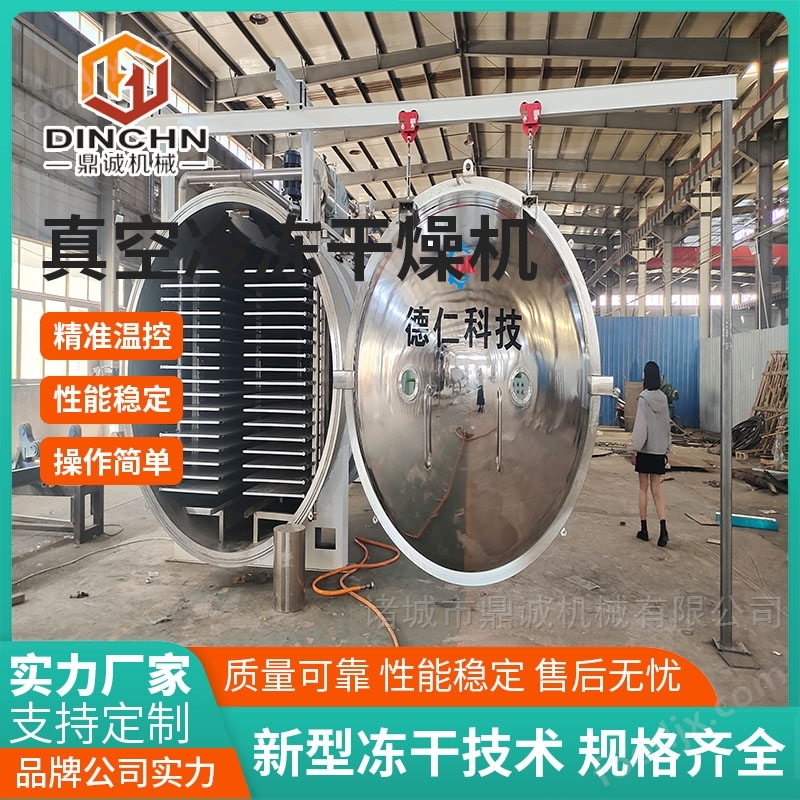
Tianma vacuum freeze-drying machine
NegotiableUpdate on 02/14
- Model
- Nature of the Manufacturer
- Producers
- Product Category
- Place of Origin
Overview
The core working principle of Tianma vacuum freeze-drying machine is to use "vacuum" to reduce the sublimation temperature, protect the product structure with "low temperature", provide sublimation power through "heating", and capture water vapor with "condenser", ultimately achieving low-temperature dehydration.
Product Details
Tianma vacuum freeze-drying machineThe core working principle is to use "vacuum" to reduce the sublimation temperature, use "low temperature" to protect the product structure, provide sublimation power through "heating", and capture water vapor through "condenser", ultimately achieving low-temperature dehydration.

The huge advantages of freeze-drying technology:
Maintain shape: The product does not shrink and its volume remains almost unchanged after drying.
Preserving activity: Due to the entire process being carried out at low temperatures, there is minimal damage to thermosensitive substances such as proteins, vitamins, and microorganisms.
Tianma vacuum freeze-drying machineFormation of porous structure: The sponge like porous structure left after sublimation enables the product to quickly absorb moisture and restore its original state when rehydrated.
Extended shelf life: At extremely low moisture levels, the activity of microorganisms and enzymes is effectively inhibited, greatly extending the shelf life.

Extremely lightweight: easy to transport and store.
Sublimation is an endothermic process that requires the absorption of a large amount of heat (sublimation heat). If no heat is provided, the temperature of the material will continuously decrease due to its own sublimation and heat absorption, ultimately stopping the sublimation process.
The purpose of heating is to "compensate" for the heat consumed by sublimation, maintain the frozen layer of the material at an ideal sublimation temperature below the eutectic point (such as -20 ℃), ensure that the ice does not melt, and allow sublimation to proceed better.

The water vapor generated by sublimation will flow through the channels inside the chamber and towards the condenser (water trap) with extremely low temperature. The temperature of the condenser is usually below -40 ℃ or even -60 ℃. When water vapor encounters the surface of the condenser coil at ultra-low temperatures, it will directly condense back into solid ice and adhere to the coil. This is equivalent to a "vacuum pump" that continuously captures and fixes the water vapor inside the chamber, maintaining a high vacuum level inside the chamber.
Similar Product Recommend